exercise equipments in grayscale photography

Understanding RPE and RIR: Key Differences in Training Efforts

Learn the difference between RPE and RIR, how to rate the effort of each gym set, and other useful ways to track workout difficulty and performance.


7/3/202615 min read

RPE vs RIR: Recording effort for your workout.

The weight and number of repetitions (reps) performed during a workout can provide valuable insight into the training load. However, they often do not fully capture the true difficulty level of a set.

Consider two athletes bench pressing the same weight of 60 kg for eight reps. For one, this may be an exhausting challenge just shy of their maximum effort, while for the other, it serves as a light warm-up.

This is where RPE and RIR can help. Both methods allow you to record how close a set was to your current limit.

In simple terms:

  • RIR tells you how many good reps you had left

  • RPE tells you how hard the set was on a scale

When using the common strength-training RPE scale, RPE and RIR describe roughly the same thing from opposite directions.

What Does RPE Mean?

RPE stands for Rating of Perceived Exertion.

It is a way of recording how difficult an exercise or workout felt to you.

Several types of RPE scale exist. In gym and strength-training programmes, RPE commonly uses a scale from 1 to 10.

On the resistance-training version of the scale:

  • RPE 10 is a maximum-effort set

  • RPE 9 means you probably had one good rep left

  • RPE 8 means you probably had two good reps left

  • RPE 7 means you probably had three good reps left

This strength-training scale was developed around the idea of reps remaining at the end of a set. It allows the weight to be adjusted according to how the lifter is performing on that particular day

What Does RIR Mean?

RIR stands for reps in reserve.

It is your estimate of how many additional good-quality reps you could have completed before reaching muscular failure.

For example:

  • 3 RIR means you could have completed around three more reps

  • 2 RIR means you could have completed around two more reps

  • 1 RIR means you could have completed around one more rep

  • 0 RIR means you could not complete another good rep

Suppose you finish a set of squats after eight reps and believe you could have completed another two with acceptable technique.

You would record that set as:

8 reps at 2 RIR

RIR is intended to describe your proximity to muscular failure, not simply how uncomfortable or tiring the exercise felt.

RPE vs RIR: The Main Difference

RPE counts upwards as effort increases. RIR counts downwards as you move closer to failure.

A hard set therefore has a high RPE but a low RIR.

The relationship is often summarised as:

RPE 10 = 0 RIR

RPE 9 = 1 RIR

RPE 8 = 2 RIR

RPE 7 = 3 RIR

This conversion is most useful near the end of a challenging set. Ratings become less precise when a set is very easy and you have many reps remaining.

Is RPE Exactly the Same as RIR?

Not always.

In many modern strength programmes, RPE is specifically linked to RIR. Under this system, an RPE 8 set is approximately the same as a 2 RIR set.

However, RPE can also be used more generally to answer:

“How difficult did that feel?”

Someone might give a high general RPE because a set caused a strong burning sensation, breathlessness or discomfort, even when several more reps were physically possible.

RIR asks a more specific question:

“How many more good reps could I have completed?”

For resistance training, this can make RIR easier to interpret because it focuses on remaining performance rather than discomfort alone.

Research has highlighted the importance of separating effort from discomfort. A high-rep leg exercise may feel extremely uncomfortable before the muscle has reached complete failure.

When RepMD asks for RPE or RIR, it should therefore be understood as a rating of set effort and proximity to failure, not pain.

What Counts as a “Good Rep”?

When estimating RIR, only count reps you could complete with acceptable technique. For example, do not count a rep that would require:

  • A much shorter range of motion

  • Excessive swinging or momentum

  • Assistance from a training partner

  • A major breakdown in your normal technique

  • Turning the movement into a different exercise

If you could technically move the weight again but only by significantly changing your technique, you may already be at 0 RIR for good-quality reps.

Your standard does not need to be absolutely identical during every rep, but it should be consistent enough to make your training log meaningful.

Should You Record RPE or RIR?

You normally do not need to record both. Because the common lifting RPE scale is based on RIR, entering:

RPE 8 and 2 RIR

is mostly recording the same information twice. Choose the method that feels easiest to understand for you, research suggests that most athletes find it easier to estimate their reps in reserve, than their rate of exertion.

RIR May Be Better If You Think in Reps

RIR may suit you if your natural thought after a set is:

  • “I had two more”

  • “I could probably have done one more”

  • “That was definitely my final rep”

It is simple, direct and closely linked to how most people already judge a set.

RPE May Be Better If Your Programme Uses RPE Targets

Converse to what we have just discussed, it is common for set programs to have an effort prescription per set that is in RPE, thus RPE may suit you if your training programme says things such as:

  • Work up to a set of five at RPE 8

  • Complete three sets at RPE 7

  • Do not exceed RPE 9 today

It is also useful when selecting a weight based on your performance that day rather than following a fixed percentage.

Consistency Matters Most

Neither scale is automatically better for every user. The most useful system is usually the one that:

  • You understand

  • You will record consistently

  • Helps you select an appropriate weight

  • Allows you to compare similar workouts over time

Avoid switching between different meanings of RPE. Decide whether your RPE rating represents proximity to failure or a general feeling of workout difficulty.

How Accurate Are RPE and RIR?

RPE and RIR are estimates, not exact measurements.

You cannot know with complete certainty how many reps remained unless you continue the set until you actually fail. Doing that during every set would create unnecessary fatigue and may not be appropriate for every exercise.

Research suggests that RIR can be used reliably in some resistance-training settings, but accuracy varies between people, exercises and rep ranges. One study involving 141 gym users found that participants were not perfectly accurate when predicting how many reps they could complete before failure. More experienced trainees tended to make better estimates, but they were still not exact.

Other research indicates that RIR estimates tend to become more accurate when:

  • You are closer to failure

  • You are using lower or moderate rep counts

  • You are familiar with the exercise

  • You have experience judging your own performance

Estimating whether you had one or two reps left is normally easier than deciding whether you had six or seven.

How to Improve Your RIR Accuracy

Rate the Set Immediately

Record your RIR shortly after finishing the set. Waiting until the end of the workout makes it easier to forget how the individual set felt.

Use Familiar Exercises

RIR is easier to estimate on exercises you perform regularly.

It may be more difficult when:

  • You are learning a new movement

  • You use unfamiliar equipment

  • Your technique is inconsistent

  • The machine has a different resistance profile

Compare Against Previous Workouts

Look at what you completed previously with the same weight.

If you recorded 10 reps at 2 RIR last week, but now complete 10 reps at 1 RIR, the current set may have been more difficult, even though the numbers are unchanged.

Occasionally Calibrate Your Estimate

On an appropriate and safe exercise, you can occasionally continue a final set beyond your intended RIR to see whether your estimate was realistic.

For example, you may stop at what you believe is 2 RIR and then, on a planned workout, test whether approximately two good reps genuinely remained. As your strength increases, you may find you need to revisit how easy or hard you find each exercise.

Use the Same Technical Standard

Your estimate becomes less useful if your definition of an acceptable rep changes between workouts.Keep your range of motion and technique reasonably consistent.

Different Ways to Document Workout Effort

RPE and RIR are useful, but they should not replace the basic details of your workout.

A complete training log should show both:

  • What you did

  • How difficult it was

The following methods record different ways of measuring your training.

1. Weight, Reps and Sets

Recording the weight, reps and sets provides the foundation of your workout history.

For example:

Bench press: 70 kg × 8, 8, 7

This shows your completed performance, sometimes described as the external training load.

However, it does not show whether the sets were easy, challenging or taken to failure.

Compare:

70 kg × 8 at 4 RIR

with:

70 kg × 8 at 0 RIR

The same weight and reps produced two very different levels of effort.

For most gym users, the best starting point is therefore:

Weight + reps + RIR or RPE

2. Record Set Effort With RIR or RPE

Alongside the weight and reps, you can record either RIR or set RPE to show how difficult each set was.

You normally do not need to record both. When using the RIR-based lifting scale, they communicate roughly the same information in opposite directions.

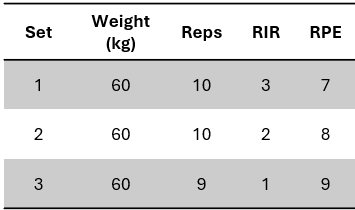
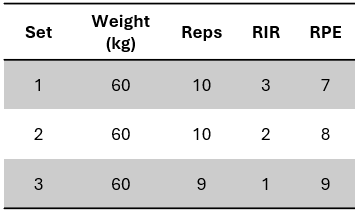
This bench press example shows that the sets became harder as fatigue accumulated.

Recording effort alongside your weight and reps can help you:

  • Compare similar sets more accurately

  • Adjust the weight based on how you are performing that day

  • Recognise when a weight is becoming easier

  • Manage progression without taking every set to failure

Choose either RIR or RPE based on which system you find easier to understand and use consistently.

3. Session RPE

Set RPE describes one set. Session RPE describes the workout as a whole.

After finishing your workout, ask:

“How hard was that entire session?”

You could use a simple 0–10 scale from easy to max, or simply just document easy/moderate/hard/max.

Session RPE can help you recognise patterns that individual sets may not show.

For example, your lifting numbers might look normal, but the whole workout could feel unusually difficult because of poor sleep, illness, stress or accumulated fatigue.

Research has found session RPE to be a practical way of monitoring the overall difficulty of resistance-training sessions. However session RPE should not be treated as interchangeable with set RPE. A set rated RPE 9 means that particular set was close to your maximum. A session rated 9 means the entire workout felt extremely difficult.

4. Session Training Load

Some coaches multiply session RPE by workout duration to create a simple training-load score.

For example:

Session RPE 7 × 60 minutes = a training-load score of 420

This can help compare the overall demand of different training days.

However, it is only an estimate. A longer workout may receive a higher score even when much of the time was spent resting, setting up equipment or waiting for a machine. Session RPE is best viewed as one part of your training record rather than a perfect measurement.

5. Percentage of One-Rep Max

Training load can also be recorded as a percentage of your one-rep maximum, normally written as %1RM.

If your squat 1RM is 100 kg:

  • 60 kg is 60% of your 1RM

  • 75 kg is 75% of your 1RM

  • 90 kg is 90% of your 1RM

Percentage-based training is commonly used in strength programmes such as Jim Wendler’s 5/3/1, because it provides a structured way to choose loads.

However, %1RM does not tell you exactly how hard a set will feel.

Two people may be able to complete different numbers of reps at the same percentage. Your performance at a given percentage can also change depending on fatigue, sleep, stress and how recently your 1RM was tested.

For this reason, some programmes combine a percentage with RPE or RIR.

For example:

3 sets of 5 at 75% 1RM, stopping at approximately 2 RIR

The percentage provides the planned load, while RIR checks whether the actual effort is appropriate.

6. Estimated One-Rep Max

An estimated one-rep max, or e1RM, uses the weight and reps from a submaximal set to estimate your maximum strength. For example, a training app may use a set of 80 kg for eight reps to calculate an estimated maximum. This can be helpful for tracking strength without testing a true maximum regularly.

However, an e1RM is an estimate. Its accuracy depends on factors including:

  • The formula used

  • The exercise

  • Your individual rep ability

  • How close the set was to failure

  • Your technique

  • Whether the set involved a true maximum effort

A set completed with four reps in reserve should not be treated like an eight-rep maximum. Recording RIR alongside the set can therefore provide important context.

7. Rep-Max Sets

A rep maximum describes the most weight you can lift for a particular number of reps with acceptable technique. Examples include:

  • 1RM: your maximum for one rep

  • 5RM: your maximum for five reps

  • 10RM: your maximum for 10 reps

A true 10RM should mean that an 11th good rep was not available. A rep-max set therefore indicates approximately 0 RIR.

This method is simple, but repeatedly testing rep maximums can be tiring. You do not need every working set to be a rep-max attempt.

8. Failure or Non-Failure

A simple workout log may record whether a set reached muscular failure or not.

Failure can be useful information, but it is less detailed than RIR. “Not to failure” could mean you stopped with one rep left or ten reps left. Those sets would create very different demands.

RIR provides a clearer estimate of how far you were from failure.

9. Lifting Velocity

Some athletes use sensors to measure how quickly a bar moves. As fatigue increases during a set, the lifting portion of each rep will often become slower. Velocity-based training can use this information to:

  • Estimate relative load

  • Monitor fatigue within a set

  • Adjust the weight

  • End a set after a chosen amount of velocity loss

Velocity provides an objective measurement, but it requires suitable equipment and careful interpretation. The relationship between bar speed and RIR can vary between exercises, loads and individual lifters. A study comparing bar velocity with RIR concluded that velocity did not accurately identify remaining reps across all tested conditions.

For most recreational gym users, RIR or RPE is more practical than purchasing a velocity sensor.

10. Workout Notes

Numbers do not explain everything. A short note can record useful context such as:

  • Poor sleep

  • Unusually high stress

  • Different equipment

  • Shorter rest periods

  • Pain or discomfort

  • A change in technique

  • Training earlier or later than usual

  • Reduced energy

  • Returning after illness

  • Using straps, a belt or other equipment

For example:

80 kg × 8 at 2 RIR — slept poorly and used a different bench

This can help explain why a workout felt different from the previous one. Notes should support your performance data rather than replace it.

Effort Is Not the Same as Pain

RPE and RIR should not be used to record injury pain. A set can be:

  • High effort but pain-free

  • Low effort but painful

  • Uncomfortable without being close to failure

  • Close to failure without causing joint pain

Muscular burning during a high-rep set may feel unpleasant, but it is not the same as a sharp, sudden or worsening pain. Use a separate note or pain field to document discomfort. Do not interpret pain as evidence that a set was productive.

Research has shown that people can confuse exercise effort with discomfort unless they are specifically asked to separate the two.

A Practical Effort-Tracking System

Most gym users do not need to record every possible measurement.

A practical system is after each working Set record:

  • Weight

  • Reps

  • RIR or RPE

  • Any important note

Example:

After the Workout

Record:

  • Session RPE

  • Workout duration, if useful

  • General notes about energy, recovery or pain

Example:

Session RPE: 7

Notes: Good upper-body session. Slightly tired at the start but performance improved after warming up. No pain.

This provides enough information to understand:

  • What you completed

  • How close your sets were to failure

  • How difficult the overall workout felt

  • Whether anything affected your performance

How RPE and RIR Help With Progression

RPE and RIR can show progress that may not be obvious from weight and reps alone.

Imagine you record:

Week 1: 60 kg × 10 at 1 RIR

Four weeks later, you complete:

Week 5: 60 kg × 10 at 3 RIR

The weight and reps have not changed, but the set has become easier. You may now be ready to add reps or increase the weight.

Alternatively:

Week 1: 60 kg × 10 at 2 RIR

Week 5: 65 kg × 10 at 2 RIR

You have completed the same reps at the same relative effort with a heavier weight. That is clear progress.

Effort ratings can therefore make your training history more meaningful, and in some programs are used to guide when to increase weight.

Using RPE or RIR to Select a Weight

RPE and RIR can also help you choose the weight before or during a workout. Suppose your programme says:

Dumbbell bench press: 3 sets of 8–12 at 2 RIR

You choose 24 kg dumbbells and complete 12 reps, but you believe another five reps were available. The weight was probably too light for the target effort. You might increase the weight during the next set. Alternatively, you complete eight reps and believe you could not perform another, that is 0 RIR, so the weight may be too heavy for the planned 2 RIR target.

RPE and RIR allow your programme to respond to your actual ability that day instead of assuming you will always perform identically.

Common RPE and RIR Mistakes

Counting Poor-Quality Reps

Only count additional reps that you could complete with acceptable technique.

Rating the Set Before You Perform It

A programme may give you a target RPE, but your recorded RPE should describe what the completed set actually felt like.

Assuming RIR Is Exact

RIR is an estimate. Do not treat 2 RIR as though it has been measured with laboratory precision.

Using Both Scales Without a Reason

Recording RPE 8 and 2 RIR adds little extra information when your RPE scale is already based on RIR. Choose one and use it consistently.

Comparing Different Exercises Directly

A set of squats at RPE 8 may feel very different from a set of biceps curls at RPE 8. The rating describes proximity to your limit for that exercise, not identical discomfort or whole-body fatigue.

Ignoring Rest Periods

A short rest can make the next set feel harder even when the weight remains unchanged. Try to keep rest periods reasonably consistent when comparing workouts.

Turning Every Set Into a Test

You do not need to reach 0 RIR to prove that your estimate is accurate. Most training can be completed without taking every set to the max, unless this is part of your training style or program.

Frequently Asked Questions

Is 0 RIR the Same as Failure?

0 RIR means you believe no additional good rep was available. You may have completed your final rep successfully without attempting and failing the next one. Muscular failure normally means you actually attempt another rep but cannot complete it with the required technique.

Should Beginners Use RPE or RIR?

Beginners can use either, but their estimates may initially be inaccurate. Its reasonable to start with broad ratings such as:

  • Easy: 4 or more RIR

  • Moderate: around 3 RIR

  • Hard: around 1–2 RIR

  • Maximum: 0 RIR

Accuracy should improve as you become more familiar with the exercises and your own performance.

Should I Record RIR for Warm-Up Sets?

Usually, detailed RIR ratings are most useful for working sets. You can record a warm-up as easy without trying to decide whether six, seven or eight reps remained, especially as the accuracy for RIR or RPE drops off beyond the equivalent of 5 reps remaining (RPE 5).

Which Method Should I Use in RepMD?

For most resistance-training workouts, record:

  • Weight

  • Reps

  • Either RIR or set RPE

  • A brief note when something important changes

You can also add a session RPE after completing the workout to show how difficult the session felt overall, but RepMD will also calculate your overall session effort based across all the sets logged.

Know what you lifted, and how hard you worked.

Use RepMD Workout Coach to record your weights, sets, reps and effort so you can make better progression decisions.

The Bottom Line

RPE and RIR both help you record the effort of a resistance-training set. RIR tells you how many good reps you believe remained:

  • 2 RIR means approximately two reps remained

  • 1 RIR means approximately one remained

  • 0 RIR means no more good reps were available

The common lifting RPE scale expresses the same idea in the opposite direction:

  • RPE 8 is approximately 2 RIR

  • RPE 9 is approximately 1 RIR

  • RPE 10 is approximately 0 RIR

Neither method is perfectly accurate, but both add useful context to your workout history.

For most gym users, the most practical record is:

Weight + reps + RIR or RPE

You can then add session RPE and short workout notes to document how demanding the overall session felt.

Do not focus on finding a perfect score. Choose a method you understand, apply it consistently and use it to make better decisions across your future workouts.

References

  • Zourdos MC, Klemp A, Dolan C, et al. “Novel Resistance Training-Specific Rating of Perceived Exertion Scale Measuring Repetitions in Reserve.” Journal of Strength and Conditioning Research. 2016;30:267–275. DOI: 10.1519/JSC.0000000000001049.

  • Helms ER, Cronin J, Storey A, Zourdos MC. “Application of the Repetitions in Reserve-Based Rating of Perceived Exertion Scale for Resistance Training.” Strength and Conditioning Journal. 2016;38:42–49. DOI: 10.1519/SSC.0000000000000218.

  • Steele J, Endres A, Fisher J, Gentil P, Giessing J. “Ability to Predict Repetitions to Momentary Failure Is Not Perfectly Accurate, Though Improves With Resistance Training Experience.” PeerJ. 2017;5. DOI: 10.7717/peerj.4105.

  • Lovegrove S, Hughes L, Mansfield S, Read P, Price P, Patterson SD. “Repetitions in Reserve Is a Reliable Tool for Prescribing Resistance Training Load.” Journal of Strength and Conditioning Research. 2022;36:2696–2700.

  • Hackett DA, Cobley S, Davies T, Michael S, Halaki M. “Accuracy in Estimating Repetitions to Failure During Resistance Exercise.” Journal of Strength and Conditioning Research. 2017;31:2162–2168. DOI: 10.1519/JSC.0000000000001683.

  • Day ML, McGuigan MR, Brice G, Foster C. “Monitoring Exercise Intensity During Resistance Training Using the Session RPE Scale.” Journal of Strength and Conditioning Research. 2004;18:353–358. DOI: 10.1519/R-13113.1.

  • Sweet TW, Foster C, McGuigan MR, Brice G. “Quantitation of Resistance Training Using the Session Rating of Perceived Exertion Method.” Journal of Strength and Conditioning Research. 2004;18:796–802.

  • Haddad M, Stylianides G, Djaoui L, Dellal A, Chamari K. “Session-RPE Method for Training Load Monitoring: Validity, Ecological Usefulness, and Influencing Factors.” Frontiers in Neuroscience. 2017;11:612. DOI: 10.3389/fnins.2017.00612.

  • García-Ramos A. “Resistance Training Intensity Prescription Methods Based on Lifting Velocity Monitoring.” International Journal of Sports Medicine. 2024;45:257–266. DOI: 10.1055/a-2158-3848.

  • Hughes LJ, Banyard HG, Dempsey AR, Peiffer JJ, Scott BR. “The Velocity of Resistance Exercise Does Not Accurately Assess Repetitions-in-Reserve.” Journal of Strength and Conditioning Research. 2024.

  • Orange ST, Metcalfe JW, Robinson A, et al. “Velocity-Based Resistance Training on 1-RM, Jump and Sprint Performance: A Systematic Review of Clinical Trials.” Sports Medicine–Open. 2022.

Connect

We welcome feedback.

Engage

© 2025 Sadler Studios Ltd. Company no. 16652298. All rights reserved.